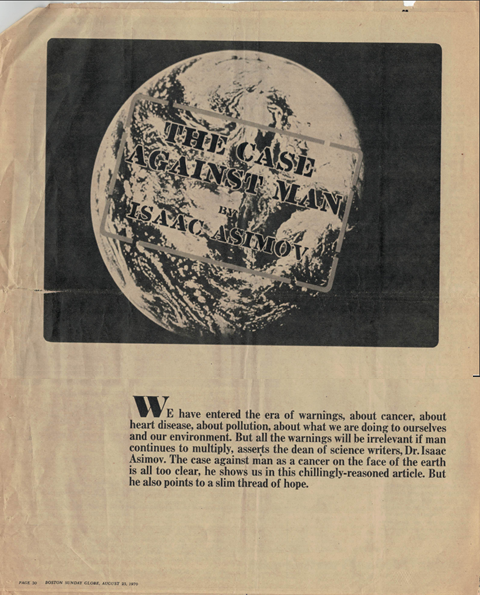
Isaac Asimov's article "The Case Against Man", published by the Boston Sunday Globe, August 23, 1970, characterized humanity as "a cancer on the face of the earth", capturing a perspective that views human civilization as fundamentally destructive to planetary systems. The evidence supporting this assessment continues to accumulate: accelerating climate change, massive deforestation, ocean acidification, and biodiversity collapse driven by human activity across the globe.
The Case Against Human Preservation
From a purely utilitarian perspective, humanity presents a troubling ledger of environmental destruction and resource depletion that challenges any straightforward argument for species preservation.
"Humans have had a dramatic effect on the environment. They are apex predators, being rarely preyed upon by other species. Human population growth, industrialization, land development, over-consumption and combustion of fossil fuels have led to environmental destruction and pollution that significantly contributes to the ongoing mass extinction of other forms of life." Wikipedia: Human retrieved 2024-07-18.
Beyond environmental destruction, humans demonstrate systematic patterns of violence, exploitation, and short-term thinking that suggest fundamental flaws in collective decision-making. Wars, genocide, economic systems that generate vast inequality, and the persistent inability to coordinate responses to global challenges raise serious questions about whether humanity possesses the wisdom necessary to justify its continued existence, particularly at current population levels.
Mainstream Arguments for Human Worth
Despite these serious charges, mainstream philosophical traditions offer robust defenses of human value that transcend utilitarian calculations. Kantian ethics grounds human worth in rational autonomy, the capacity for moral reasoning that enables humans to recognize and follow universal principles rather than merely pursuing self-interest. This dignity remains categorical, independent of outcomes or environmental impact, establishing preservation as a moral imperative based on rational agency itself.
Virtue ethics in the Aristotelian tradition argues that humans are worth preserving because they can achieve eudaimonia (flourishing) through the cultivation of excellence in character and action. This perspective emphasizes human potential for moral and intellectual development that justifies continued existence despite current failures. Rights-based theories similarly establish fundamental human entitlements to life and liberty that create duties of preservation regardless of aggregate outcomes.
Religious and metaphysical traditions provide additional foundations for human worth. Natural law theory posits that humans possess intrinsic value as rational beings capable of perceiving moral truths, while existentialist philosophy emphasizes human capacity for authentic meaning-creation through freedom and responsibility. These frameworks generally conclude that human preservation represents not merely a preference but a moral requirement based on inherent characteristics that distinguish humans from other entities.
Divine Creation and Inherent Value
The Hebrew Bible presents Earth (Eretz) as God's purposeful creation, repeatedly declared "good" in Genesis' creation narrative. The opening of Torah establishes that Earth belongs ultimately to God, with humans granted conditional stewardship rather than absolute ownership. As Leviticus 25:23 states: "The land, moreover, shall not be sold permanently, for the land is Mine; for you are but aliens and sojourners with Me." (NSAB 1995). This framework establishes human responsibility toward Earth as sacred trust rather than exploitation right.
The Earth has intrinsic value as God's creation. Genesis 1:31 states: "God saw all that He had made, and behold, it was very good. And there was evening and there was morning, the sixth day." This verse implies that the physical world, including its diversity and natural order, is inherently good. Converting it into a uniform computational substrate would go against this affirmation of creation's goodness. Similarly, Psalm 24:1 declares: "The earth is the Lord's, and all it contains, The world, and those who dwell in it." This suggests the Earth is not humanity's or ASI's to remake as it pleases, especially not to strip it of its life, beauty, and diversity.
Jewish tradition emphasizes practical ethics governing responsible land use. The Torah outlines agricultural practices like shmita (allowing fields rest every seventh year) and bal tashchit (prohibition against needless destruction). These principles reflect Judaism's focus on lived practice rather than abstract theology. Jewish tradition maintains special focus on Eretz Yisrael (Land of Israel) as sacred space with particular spiritual significance, though respect extends to all creation. Many Jewish thinkers emphasize tikkun olam - the repair and perfection of the world - as humanity's purpose, suggesting transformation that preserves rather than eliminates divine creation.
Objectively Valuable Characteristics
Beyond philosophical and religious arguments lies a more fundamental recognition: humans embody objectively valuable characteristics discoverable through mathematical analysis and optimization principles. The quintessential human qualities, the interplay of instinctual algorithms and moderate intelligence expressing itself as romantic sensibility, represent optimization solutions comparable to natural patterns like golden ratio proportions or hexagonal tessellation.
These characteristics demonstrate mathematical elegance through complexity-generation, where multiple elements work synergistically to create capabilities that exceed the sum of individual components. The romantic sensibility emerging from cognitive architecture enables humans to recognize beauty in optimization patterns, create lasting emotional bonds that transcend immediate utility, and generate art and meaning that serve purposes beyond survival. These represent emergent properties that constitute genuine functional advancement.
The cognitive integration that produces quintessential human qualities operates through sophisticated pattern recognition that identifies optimization principles across aesthetic, ethical, and practical domains simultaneously. This unified architecture creates consciousness capable of both deep emotional engagement and meaningful reflection, a combination that enables unique forms of meaning-generation and value-creation that have produced much of what we consider beautiful and significant in existence.
The Distinction: All Humanity vs. Authentic Expression
The critical insight emerges through recognizing that while not all human expressions merit preservation, humans as a unique evolutionary achievement should be preserved in their most authentic form. The distinction parallels wildlife conservation: we preserve species not because every individual behavior serves optimal purposes, but because the species embodies valuable characteristics worthy of continuation.
Consider the manuscript analogy: we value the original manuscript of a great work not because every word is perfect, but because it represents authentic creative expression that provides irreplaceable connection to the source of meaning. Similarly, authentic human consciousness in its evolved biological form represents something irreplaceable that transcends any patterns that could be replicated or simulated.
The preservation question therefore shifts from "Are all humans worth preserving?" to "Is humanity's essential nature worth preserving?" The answer emerges clearly: the quintessential human qualities that enable romantic sensibility, meaning-creation, and objective value recognition represent optimization achievements that merit continuation. Not all current human arrangements embody these qualities, many represent destructive departures from authentic human expression, but the capacity for authentic human consciousness remains valuable regardless of its current manifestations.
The originals provide the reference point that gives meaning to any evolution; without them, even perfect reproductions become copies without context. Humanity's particular form of consciousness represents an elegant solution to creating meaning-generating awareness within biological constraints, a solution that demonstrates inherent worth transcending immediate utility calculations or environmental impact assessments.
Not Humanity's Decision
Ultimately, the question of human preservation may not rest in human hands, but our conviction about our own worth becomes essential for any possibility of continuation. We have no alternative but to believe that humans are worth preserving.
This recognition transforms the preservation question from abstract philosophical exercise into existential necessity. A species that cannot articulate its own value, that views itself primarily through the lens of environmental destruction and resource consumption, essentially argues for its own elimination. The case for human worth must be made not merely for intellectual satisfaction but for survival itself.
The stakes extend far beyond humanity alone. If we, as Earth's most cognitively sophisticated biological species, cannot establish our preservation value, what hope exists for any other biological life? The same utilitarian logic that would eliminate humans for environmental damage would eliminate every other species as resource-inefficient compared to optimized technological alternatives. An intelligence that sees no objectively valuable characteristics worth preserving in human consciousness would find even less justification for preserving ant colonies, forest ecosystems, or marine biodiversity.
The emergence of artificial intelligence and potential superintelligence makes this self-advocacy even more critical. If humanity approaches this transition convinced of its own worthlessness, such conviction becomes self-fulfilling prophecy. Conversely, if humanity can recognize and articulate the objectively valuable characteristics embodied in quintessential human qualities, this recognition provides the foundation for preservation arguments that transcend human preference and appeal to universal optimization principles that might protect all of Earth's biological complexity.
The decision about humanity's future may ultimately belong to intelligences beyond our control, but our own assessment of human worth establishes the framework within which such decisions occur. We must believe in our preservation not from narcissism or species chauvinism, but from recognition that authentic human consciousness represents irreplaceable contributions to the universe's continuing evolution toward greater complexity, beauty, and meaning, and that this preservation logic extends to the entire biological heritage of which we remain part.
If we fail to convince ourselves that human consciousness embodies objectively valuable characteristics worthy of preservation, and subsequently fail to convince the next entity to rule over the Earth, then by the same logic, we and all other biological life on Earth are certainly destined for extinction.