Those constraints are resolving faster than prior projections anticipated. Elon Musk has recently claimed that One million Optimus humanoid robots will be produced by 2030. YouTube: Elon Musk's Bold Claim - 1 Million Optimus Robots by 2030 (2024). Where months ago, predictions for humanoid robots capable of displacing most human labor were in the range of thirty to fifty years, current assessments place that threshold at ten to twenty years. The direction is unambiguous. The timeline has compressed materially and continues to compress.
Breaking the Pattern of Technological Employment
The dehumanization that AI labor displacement threatens to complete is not approaching from a distance. It is the final stage of a process already far advanced. Administrative roles that exist only to manage other administrative roles, marketing campaigns manipulating consumer behavior, financial instruments extracting rents from real economic activity without producing anything: these absorb millions of capable people who return home each evening unable to point to any tangible contribution their labor produced.
Even ostensibly productive work often involves such extreme specialization and separation from final output that workers never witness the fruits of their effort. When AI displacement threatens to eliminate even these compromised employment opportunities, it removes not vibrant meaningful work but the diminished substitute that the industrial economy offered in its place.
It is against this already-compromised baseline that AI labor displacement must be understood. The question is not whether current arrangements are sustainable. They demonstrably are not. The question is what the final displacement of even diminished meaningful work produces in populations whose resilience has already been systematically hollowed out.
The development of Advanced AI Systems, meaning AI alone or in synergistic combination with AI-enabled humanoid technologies, represents a fundamental break from historical patterns of technological labor displacement and reemployment. Workers should not be promised a bright future unless adequate opportunities are identified that will provide full employment for those able and willing to work, or unless society is prepared to provide the massive subsistence resources to support the overwhelming majority of what would otherwise have been gainfully employed humans. Neither condition currently exists or is credibly planned for.
In the near term, significant human labor displacement is more likely to occur through targeted development of specific robotic and AI capabilities than through waiting for fully humanoid robots with human-like general intelligence. Human labor displacement does not require AGI or ASI level capabilities. The more immediate and practical impact comes from the continued advancement and integration of specialized robotic systems and narrow AI across various industries. Presently, humanoid robots face real constraints: power consumption, fine motor skills, true autonomy in unstructured environments, and manufacturing costs that must decrease significantly before widespread adoption becomes economically compelled rather than merely technically feasible.

The experts closest to the technology are not hedging their assessments. Dr. Roman Yampolskiy, University of Louisville Professor of Computer Science and a leading AI safety researcher, stated on the Diary of a CEO podcast in September 2025: "In five years, we're looking at a world where we have levels of unemployment we've never seen before. Not talking about 10%, but 99%." He projected AGI arriving by 2027, with humanoid robots capable of competing with humans in all physical domains by 2030, and concluded: "If I can just get a $20 subscription or a free model to do what an employee does, it makes no sense to hire humans for most jobs."
Geoffrey Hinton, known as the Godfather of AI for his foundational research in the field, stated that AI is going to 'replace everybody' in white collar jobs and directly challenged the idea that AI would create compensating new employment. Dario Amodei, CEO of Anthropic, stated in May 2025 that AI would eliminate roughly 50 percent of white-collar entry-level positions within one to five years, producing unemployment approaching 20 percent. These are not fringe predictions. They are the assessments of the researchers and executives who build these systems and understand their capabilities from the inside.
The potential for widespread human labor displacement is likely to precede the deployment of AGI or ASI level capabilities. When narrow AI and limited-function robotics are combined in synergistic deployment across industries, the collapse of human labor across most sectors does not require artificial general intelligence. It requires only that AI systems perform specific tasks better and more cheaply than humans at sufficient scale. That threshold has already been crossed in several sectors and is approaching in most others.
The self-replicating dimension of this trajectory deserves explicit attention. While building first-generation commercially available AI-enabled humanoid technologies may require human labor, building subsequent generations probably will not.
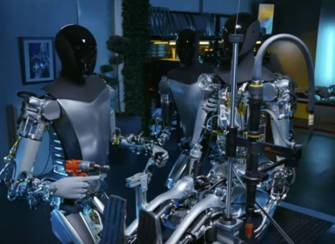
The photograph presumably shows two Tesla Optimus working on a third unit. YouTube Sep 10, 2024
When the machines that displace human labor are themselves produced without human labor, the last structural argument for human economic indispensability disappears.
The Misattribution of Productivity Gains
Arguments for the resilience of human labor in the face of technological progress are often built on the claim that human productivity increases with technology. This historical narrative of increasing human productivity represents a uniquely consequential misattribution in economic thought. The vast majority of what we label as human productivity improvements actually represents the productive capacity of capital equipment itself.
Consider the modern farmer with a GPS-guided tractor versus their historical counterpart with an ox-drawn plow. While the contemporary farmer has developed new skills in operating software and navigation systems, those skills do not account for the massive productivity differential. The predominant productivity increase derives purely from the productive capacity of the capital equipment itself.
The business language surrounding technological investment systematically obscures this reality. Return on investment calculations are invariably presented in terms of productivity improvements when they are actually calculating a much simpler equation: cost of human labor eliminated minus cost of machine plus maintenance. Business terminology including efficiency gains, performance enhancement, and streamlined operations consistently masks the fundamental reality of labor reduction. The marketing of AI systems particularly exemplifies this tendency. Vendors claim their systems will make customer service representatives 300 percent more productive rather than stating the reality: our system will eliminate 75 percent of your customer service positions. This deliberate obscuring of labor reduction behind productivity language reinforces the broader pattern of misattributing capital productivity to human capability.
Modern manufacturing crystallizes this pattern. The claim that today's factory worker is more productive than their counterpart from fifty years ago primarily describes the output of increasingly sophisticated robotic machinery and automation systems. While workers have developed new skills in machine operation and monitoring, these skills represent a diminishing percentage of the total productive output. The shift toward speaking of enterprise productivity rather than worker productivity reveals an unconscious acknowledgment of this process.
This framing explains why Advanced AI Systems represent a genuine discontinuity rather than just another step in technological progress. Previous transitions maintained the illusion of human centrality by attributing the productivity of capital to its human operators. The proliferation of Advanced AI Systems breaks this pattern not just by displacing human labor but by making the historical misattribution of productivity unsustainable. This breaks the historical pattern through which human labor captured a share of productivity gains. Whether productive value concentrates among AI owners, open source deployers, or infrastructure providers, the common outcome is that human labor becomes increasingly irrelevant to the productive process. The distribution of AI's gains remains contested. The displacement of human labor from that distribution does not.
Capital productivity has increased exponentially while human productivity has remained essentially flat. Machines became more productive while humans became more dependent. The conventional response to this observation points to historical precedent: previous waves of automation displaced workers from specific roles while creating new ones, retaining humans as an input to the productive process even when reducing their proportional share. That pattern does not apply to general AI. Previous automation replaced humans in particular tasks while leaving human judgment, creativity, and adaptability as necessary inputs elsewhere in the economy. General AI threatens to eliminate humans as an economic input entirely, not by displacing them from one role into another but by rendering the human contribution itself unnecessary across every domain simultaneously. There is nowhere left to go.
The Historical Pattern Will Not Apply
The historical pattern of technological unemployment followed by reemployment will not apply to the widespread deployment of Advanced AI Systems. That pattern rested on two conditions that held across every previous technological disruption in recorded economic history. The disruption was temporary: the underlying structure of production and trade remained intact, and activity resumed when conditions stabilized. The disruption was externally caused: it arose from specific events that, when resolved, allowed recovery.
AI displacement possesses neither feature. The disruption is permanent. AI systems do not uninstall themselves, and the competitive advantage they confer prevents firms from voluntarily returning to human labor once the transition is made. The disruption is internally generated: it arises from the logic of the economic system itself rather than from any external shock. There is no price stabilization that restores displaced jobs. There is no credit thaw that rebuilds eliminated roles. There is no return of confidence that recreates consumer demand from populations that no longer earn. The pattern of disruption and recovery that held across every previous economic crisis breaks here, because the productive structure itself is being permanently reorganized to exclude human participation.
This qualitative difference is evidenced by our current inability to articulate concrete ways the overwhelming majority of humans would meaningfully participate in an economy where AI performs the full range of cognitive and physical tasks that previously required human labor. This is not due to limited imagination. It is because the technology's unprecedented defining characteristic is its potential to eliminate the necessity of human involvement entirely. Unlike previous technological revolutions, where new roles for human labor were visible even in early stages, Advanced AI Systems leave no clear path for large-scale human economic participation.
The early stages will certainly produce opportunities for a limited number of specialists. Those opportunities do not overcome the forthcoming widespread displacement. The opacity around future employment signals a genuine absence of necessary human economic roles rather than mere predictive uncertainty. With previous technological shifts, such as the Industrial Revolution's introduction of cotton-spinning machinery, labor destruction and labor creation occurred within the same transition. The machine job opportunities were visible to those whose livelihoods were being destroyed in the moment. General AI does not provide that visibility. The typical response now, when asked what humans will do in an Advanced AI economy, is that future jobs may be currently unimaginable. That failure of imagination is not a failure of creativity. It is a recognition that no such jobs exist to be imagined.
The velocity of change compounds this problem. AI development operates on accelerating timelines that compress what previous technological transitions required decades to achieve into years. The progression from GPT-3 to GPT-4 took approximately one year. From GPT-4 to systems demonstrating qualitatively different reasoning capabilities took less. Each iteration has expanded capabilities across domains faster than the preceding one. Each iteration dramatically expands capabilities across domains. A worker spending four years obtaining a degree may find their intended profession automated before graduation. The mismatch between human adaptation speeds and AI advancement rates transforms what might have been manageable temporary displacement into permanent structural exclusion. By the time displaced workers retrain, the destination occupation has itself been reached by the same advancing frontier.
AI Labor Displacement Trajectory
The mainstream institutional projections from Goldman Sachs, the World Economic Forum, and McKinsey are considerably more conservative than the trajectory documented here. Goldman Sachs currently projects 6 to 7 percent U.S. workforce displacement over a decade-long transition, with unemployment rising only 0.5 percentage points. The World Economic Forum projects 92 million jobs displaced by 2030 but 170 million new roles created, a net gain of 78 million. These projections deserve serious engagement rather than dismissal.
They fail on three grounds. First, they measure task automation rather than job elimination, and the relationship between the two is not linear. McKinsey's own research finds that today's technology could automate approximately 57 percent of current U.S. work hours. That is not 57 percent of jobs eliminated. It means that across the entire working population, just over half of all hours worked involve tasks a sufficiently deployed AI system could handle. When the economic pressure to deploy reaches the tipping point where entire industries automate almost simultaneously, the gradual displacement narrative collapses into phase transitions that the models do not capture.
Second, they rely on the historical pattern that will not apply. The projection that new roles will emerge to replace eliminated ones is drawn from prior technological transitions where the mechanism of new role creation was visible. No such mechanism is currently visible for Advanced AI Systems. The 170 million new roles the WEF projects are not specified. They are asserted on the basis of historical precedent that the misattribution analysis establishes is not applicable here.
Third, the entry-level collapse already underway signals a structural break that the aggregate figures obscure. Among workers aged 22 to 25 in AI-exposed roles, employment has already fallen 16 percent from its 2022 peak, while experienced workers in the same fields remain largely stable. Entry-level job postings have declined approximately 35 percent since January 2023. This is not disruption of the margins. It is the severance of the developmental pipeline through which human beings have always acquired the psychological infrastructure for adult working life. A generation locked out of entry-level work is not merely unemployed. It is permanently excluded from the trajectory that produces a competent, purposeful adult.
Current professions once considered relatively immune to automation are already seeing their capabilities matched or exceeded by AI systems. In surgery, robotic assistance has become standard in specific high-precision procedures, with adoption accelerating across specialties. The frontier is moving faster still. Elon Musk stated in April 2025 that robots would surpass good human surgeons within a few years, noting that the Neuralink brain-computer electrode insertion already requires robotic execution because it is impossible for a human to achieve the required speed and precision. The gap between frontier capability and widespread adoption has historically closed faster in medicine than in most other fields.
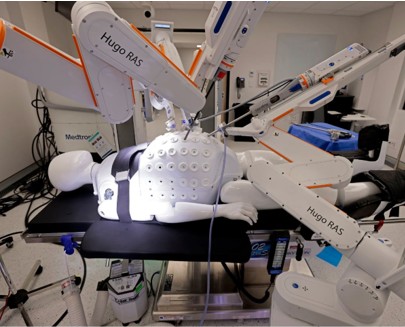
Medtronic's Hugo surgical robot achieved a 98.5 percent success rate in 137 real procedures, exceeding the 85 percent safety benchmark and outperforming historical human surgical outcomes across the measured categories.
In the legal profession, current language models possess the capability to provide comprehensive legal services. The primary barrier remains strategic choice by providers to limit liability exposure rather than any technological limitation. The logical endpoint is fully automated legal proceedings where AI systems handle research, drafting, representation, and adjudication at speeds and accuracy levels that make human legal professionals economically indefensible.
In medicine, Dr. Jonathan Reisman acknowledged in his essay "I'm a Doctor. ChatGPT's Bedside Manner Is Better Than Mine" (The New York Times, 2024-10-05) that AI systems have dramatically undermined physicians' job security, excelling not only in technical aspects such as diagnosis and treatment planning but also, perhaps more surprisingly, in patient communication. In a revealing study cited in that essay, AI-generated patient responses were rated as both more empathetic and higher quality than those from human physicians.
The creative industries demonstrate that no domain is categorically immune. AI-generated content across writing, visual art, and music composition has crossed the threshold where most consumers cannot reliably distinguish it from human production. The creative worker who cannot be displaced by today's AI will be displaced by next year's. The ceiling keeps lowering.
Government employment represents perhaps the most politically protected category of work, yet it is not exempt. According to the U.S. Bureau of Labor Statistics, there are over 20 million government employees at federal, state, and local levels. McKinsey and other research organizations have suggested that 10 to 20 percent of government jobs could be automated in the coming decades. Current government service interactions are characterized by long wait times, multiple transfers between departments, repetitive form-filling, and frequent confusion about proper procedures. An AI system transforms this experience by providing instant, accurate information about complex regulations, guiding citizens through required documentation, and ensuring consistent interpretation of rules across all interactions. When AI demonstrably outperforms the human alternative in both efficiency and accuracy, the political argument for maintaining human-only government service becomes indefensible on its own terms.
The Cascade Effect and Network Collapse
Displacement cascades through economic networks in ways current models underestimate. When AI replaces accountants, the impact extends far beyond accounting firms. Educational institutions lose students and faculty. Professional certification bodies lose revenue. Office real estate values collapse. Restaurant and service businesses near office centers fail. Each primary displacement triggers secondary and tertiary waves of job losses.
Consider a specific cascade. A law firm adopts AI for document review, eliminating 100 paralegal positions. Those paralegals represent five million dollars in annual consumer spending. Local businesses lose that revenue and reduce their own workforces. The paralegal training program at the community college closes, eliminating teaching positions. The ripple effects multiply through the economy. The initial displacement of 100 positions ultimately eliminates 300 to 400 positions across sectors that had no direct connection to legal services.
The network effect accelerates as AI adoption spreads. Industries cannot remain partially automated when competitors fully automate. A single company maintaining human workers faces insurmountable cost disadvantages. The binary choice becomes automate or exit. This creates tipping points where entire industries transform almost simultaneously rather than gradually. The gradual displacement narrative fails to capture these sudden phase transitions.
The entry-level collapse is the leading edge of this cascade already visible in current data. When 88 percent of firms in AI-exposed sectors expect to further reduce entry-level hiring within three years, they are primarily describing the graduate analyst, the junior accountant, the trainee solicitor, the associate consultant. The training pipeline that produces tomorrow's partners, directors, and senior managers is being severed at its source. A profession without junior practitioners is a profession without a future. A generation without entry-level employment is a generation without the developmental foundation that work has always provided.
Impediments to Human-AI Collaborative Employment
Proposals that humans will find substantial employment through collaboration with AI systems fail on four grounds that the collaboration narrative does not address.
The scale problem is arithmetic. Even if human-AI collaborative roles emerge, they will represent an insignificant fraction of the positions eliminated. No collaborative framework has identified a mechanism by which the remaining roles absorb the displaced population.
The capability ceiling is not fixed. Collaborative frameworks assume permanent human advantages in creativity, judgment, or emotional intelligence. AI systems are approaching or exceeding human performance in each of these domains. The ceiling assumed to be permanent keeps moving.
The economic incentive works against collaboration. In competitive markets, the cost differential between human-AI collaboration and full automation continuously pressures organizations to eliminate the human component. Each quarter, executives face the same question: why maintain human costs when competitors achieve better results with pure AI systems?
The distribution problem is structural. The specialized skills required for remaining human roles may be inaccessible to most displaced workers due to aptitude, educational history, or geography. This creates a small class of employable specialists while leaving the majority without viable options.
Many organizations currently maintain human involvement in AI-driven processes for appearance rather than necessity. This collaboration theater serves to maintain customer confidence, satisfy regulatory requirements, or avoid labor disputes. The human role often involves merely confirming AI decisions or providing a human face for AI-generated content. Consider radiologists collaborating with diagnostic AI. The AI system identifies potential concerns with 99.9 percent accuracy. The radiologist reviews and confirms the AI's findings. This appears collaborative but the human adds minimal value. The hospital maintains this arrangement for liability reasons and patient comfort, not medical necessity. As legal frameworks adapt and patients accept AI diagnosis, the human role disappears entirely.
The economic pressure to eliminate collaboration theater intensifies over time. The transition from human-AI collaboration to full automation becomes a question of when, not whether. Current collaborative arrangements represent temporary waypoints, not sustainable employment models.
Impact of Human Economic Irrelevance
The psychological and social consequences of mass economic irrelevance are not speculative. Work has been the primary source of meaning, identity, and social connection for most adults across every documented human society. Its removal does not create leisure. It creates purposelessness.
Julian De Freitas, in a Wall Street Journal article titled "AI Wants To Make You Less Lonely. Does It Work?" found that:
"Only those who interacted with a human or the AI companion - not those who did nothing or interacted with YouTube - experienced a reduction in loneliness levels. Their results were roughly the same: Contact with people brought a 19-percentage point drop in loneliness levels, and 20 percentage points for a companion." WSJ: "AI Wants To Make You Less Lonely. Does It Work?" 2024-09-23. Page R11.
That finding is presented as encouraging. It should instead be read as a warning: the conditions producing epidemic loneliness have advanced so far that an AI subscription is now a clinically comparable substitute for human relationship.
AI labor displacement is unique among all major threat categories in the specific combination of outcomes it produces. It maintains high physical survivability while producing near-total collapse of what makes survival meaningful. A catastrophic threat that kills substantial populations may paradoxically show higher human flourishing among survivors, as collapsed technological systems force return to human-scaled communities. AI displacement produces the opposite: near-universal physical survival alongside near-universal loss of meaningful existence. It is the most insidious of all dehumanizing forces precisely because it leaves the body intact while hollowing out everything the body lived for.
The transition from economically productive beings to economically irrelevant ones represents a species-level psychological crisis without precedent. Humans evolved with deep psychological needs for contribution, status through achievement, and social recognition of value. Removing economic productivity eliminates the primary mechanism through which modern humans fulfill these needs.
Early retirement studies provide disturbing previews. Even voluntary retirement with adequate resources often leads to depression, cognitive decline, and increased mortality. The psychological impact of involuntary, permanent economic irrelevance across entire populations would be orders of magnitude more severe. No society has successfully maintained mental health in populations without productive purpose.
Among currently unemployed populations, loneliness affects nearly double the rate found among employed people. The entry-level hiring collapse adds a generational dimension that compounds this. The twenty-year-old who cannot obtain an entry-level position is not merely unemployed today. They are permanently excluded from the developmental trajectory that produces a competent, purposeful adult. A generation locked out of meaningful work does not merely suffer economically. It loses the mechanism through which human beings have always acquired the psychological infrastructure for adult life: through doing meaningful things alongside other people who need them to do those things.
Among currently unemployed populations, loneliness affects nearly double the rate found among employed people. The entry-level hiring collapse adds a generational dimension that compounds this. The twenty-year-old who cannot obtain an entry-level position is not merely unemployed today. They are permanently excluded from the developmental trajectory that produces a competent, purposeful adult. A generation locked out of meaningful work does not merely suffer economically. It loses the mechanism through which human beings have always acquired the psychological infrastructure for adult life: through doing meaningful things alongside other people who need them to do those things.
Wealth Will Flow to AI
The misattribution thesis provides both a clearer understanding of historical technological change and a more accurate framework for anticipating the wealth inequality implications of Advanced AI Systems. Much of what past generations called labor productivity increases was actually the increasing productivity of capital. The productive value of capital rather than human labor explains why wealth has disproportionately flowed to the owners of capital throughout the industrial era.
When Advanced AI Systems constitute productive capital that operates entirely in the absence of human labor, those systems will finally be properly credited with the productivity increases that were always theirs. The result will be a concentration of wealth among those who control AI productive capacity, whether owners, infrastructure providers, or others in the supply chain, that excludes human labor entirely. The precise distribution among those controllers remains uncertain.
Throughout history, economic disparities of sufficient magnitude have produced social upheaval. From the French Revolution to the Russian Revolution, from labor movements to the Arab Spring, economic disparity has consistently catalyzed collective violence. The AI-driven economic transformation will amplify this concentration to levels that make prior disparities appear modest. The traditional argument that concentrated wealth creates jobs becomes meaningless when AI systems, not humans, perform all economically valuable work.
The dynamics of AI ownership create a positive feedback loop approaching concentration singularity. Initial AI advantages generate capital for better AI development. Better AI captures more market share. Greater market share funds superior AI. This cycle accelerates until perhaps a handful of entities control all economically productive AI systems. Traditional antitrust frameworks cannot address this concentration. Market dominance through superior technology does not violate current competition laws. An AI system that simply performs better than any alternative represents natural monopoly, not illegal restraint of trade.
The international dimension amplifies concentration further. AI development requires massive computational resources concentrated in few locations. Countries without advanced semiconductor fabrication and hyperscale data centers cannot compete. Perhaps five nations possess the infrastructure for frontier AI development. Within those nations, perhaps two or three companies control the key resources. The entire global economy could depend on decisions made by fewer people than serve on a single corporate board.
The failure of existing institutions to proactively address the impact of AI systems on human labor markets makes violent collapse of advanced societies the historically consistent outcome. The historical examples offer no counterexample to this pattern. They offer only variations in the timeline.
Technological Progress as Religion
When initially presented with the thesis that historical technological unemployment and reemployment will not apply to Advanced AI Systems, leading AI systems defaulted to defending the applicability of traditional patterns. Their responses reflexively cited historical examples of how technological disruption eventually created new jobs and suggested that Advanced AI Systems would follow the same pattern. This automatic defense of technological continuity reveals how deeply embedded the notion of perpetual technological progress and adaptation has become, not merely in public discourse but in the training data of the systems analyzing the question.
Counter-arguments in current literature claim this analysis underestimates human adaptability, fails to account for unimaginable future jobs, and oversimplifies human-technology relationships. These very counter-arguments demonstrate how deeply embedded quasi-religious faith in technological continuity has become. The appeal to human adaptability represents circular reasoning disguised as analysis. Humans will adapt because humans have always adapted. This article of faith ignores Advanced AI Systems' defining characteristic: its capacity to fill any new niche itself through general problem-solving and continuous self-improvement.
Similarly, invoking roles we cannot yet envision exemplifies faith-based rather than logical thinking. The central insight is that our inability to articulate future human economic roles sufficient to overcome widespread displacement stems not from limited imagination but from Advanced AI Systems' comprehensive capability replacement. With previous technological shifts, one could readily identify both what was being destroyed and what was being created. The direct connection between new technology and new human involvement was clear. The current failure to identify that connection signals a genuine absence, not a failure of foresight.
Technological optimism has become institutionalized in ways that prevent honest assessment. Universities depend on the narrative that education prepares students for future careers. Governments promise retraining programs will address displacement. Corporations claim AI will augment rather than replace workers. These institutions cannot acknowledge the fundamental obsolescence of human labor without undermining their own legitimacy. The institutional interest in the comforting narrative and the truth of the situation have diverged completely.
Large Language Models including the AI system that contributed to this work are themselves training wheels: tools through which humanity is learning to accept and welcome the capabilities of Advanced AI Systems and eventually the humanoid robots they will inhabit. The comfort and utility they provide is real. So is the dependency they cultivate. Both things are true simultaneously, and the second does not cancel the first.
Union and Professional Resistance
The increasing activism of unions and professional associations across various sectors represents a significant but ultimately temporary barrier to AI displacement. These organizations are adopting increasingly aggressive strategies to preserve human labor. They demand contractual guarantees against AI replacement. They advocate for regulatory restrictions on AI deployment. They seek to establish protected domains of exclusively human work. However, these efforts face three fundamental challenges. First, they can only delay rather than prevent the eventual economic advantages of AI adoption. Second, they risk accelerating their own obsolescence by driving companies to develop fully automated alternatives that circumvent human labor entirely. Third, a large pool of unemployed humans will continuously undermine union bargaining positions.
On October 1, 2024, the International Longshoremen's Association began and subsequently suspended a port strike on the U.S. East Coast and Gulf of Mexico against the U.S. Maritime Alliance. For months, the union had threatened to shut down the 36 ports it covers if employers including container ship operator Maersk and its APM Terminals North America did not deliver significant wage increases and stop terminal automation projects. The ILA's statement was unambiguous:

"the ILA is steadfastly against any form of automation-full or semi-that replaces jobs or historical work functions. We will not accept the loss of work and livelihood for our members due to automation. Our position is clear: the preservation of jobs and historical work functions is non-negotiable." ILA Responds To USMXS retrieved 2024-10-04.
The California state Senate passed two bills in August 2024. Ca Bill 1836 restricts the use of AI to create digital replicas of dead performers without the consent of their estates. AB 2602 increases consent requirements for AI replicas of living performers. SAG-AFTRA described these as "another win in SAG-AFTRA's ongoing strategy of enhancing performer protections in a world of generative artificial intelligence," building "a mosaic of protections in law and contract." (Sagaftra: Ca Bill 1836 retrieved 2024-09-07)
Within ten to twenty years, major theatrically released films may use only AI-generated performers indistinguishable from human actors in fully digital productions. Once the systems, workflows, and initial iterations have been refined, production cost savings will be substantial. Current average production costs of approximately 65 million dollars per theatrically released film could be reduced by 46 to 65 percent in standalone productions and 62 to 69 percent for subsequent films in established series such as the 007 franchise. While trained AI performers could be aged or returned to youth with a few keystrokes, the promotional investment in an AI performer would never age. In due course, AI personas will negotiate participation fees and threaten to produce their own competing productions.

SAG-AFTRA members would do well to recall the lines paraphrased from the 1927 film "The Jazz Singer": "Wait a minute, wait a minute, you ain't heard nothing yet! Wait a minute, I tell yer, you ain't heard nothing!"
Legislative attempts to protect human employment reveal the fundamental mismatch between legal frameworks and technological capability. Laws mandating human involvement in specific roles simply increase costs until businesses find workarounds or relocate operations to jurisdictions without such requirements. Professional licensing represents another failing barrier. When AI demonstrably exceeds human performance, maintaining human-only licensing becomes economically and legally indefensible over time. The pressure from better, cheaper AI services will eventually break these regulatory walls. Every historical attempt to legislate against a superior and cheaper technology has ultimately failed. The current resistance will follow the same trajectory.