"Do you have faith? The voice in Kazi's head buzzed around somewhere just beneath his scalp. Do you, little Kazimir? Faith can move mountains. Faith can alter reality. Faith is like having me inside you all the time. Your imaginary friend. That's who. Yes, me. You think you've seen some weird shit, kid, let me tell you, there's more where that came from."
The Transhumanist Vision
Wikipedia informs that:
"Transhumanism is a philosophical and intellectual movement that advocates the enhancement of the human condition by developing and making widely available new and future technologies that can greatly enhance longevity, cognition, and well-being." ... "Transhumanist thinkers study the potential benefits and dangers of emerging technologies that could overcome fundamental human limitations, as well as the ethics of using such technologies. Some transhumanists speculate that human beings may eventually be able to transform themselves into beings of such vastly greater abilities as to merit the label of posthuman beings." Wikipedia: Transhumanism retrieved 2024-09-04.
Yuval Harari, a professor of history at the Hebrew University in Jerusalem, captures the magnitude of this transformation:
"If we told our ancestors in the Stone Age about our lives today, they would think we are already Gods. But the truth is that even though we have developed more sophisticated tools, we are the same animals. We have the same emotions, the same minds. The coming revolution will change that. It will change not just our tools; it will change the human being itself." Fox News: Humans Will Eventually Merge With Machines July 10, 2019.
The idealization of superhuman characters like Superman and Spock reflects a deep-seated human aspiration to transcend our limitations. These characters embody different aspects of perfected human traits, Superman representing physical and moral ideals, while Spock epitomizes perfect rationality and emotional control. Their enduring appeal reveals an underlying discontent with basic human nature and a yearning for capabilities beyond our current constraints.
From Medical Necessity to Enhancement
Transhumanist technologies, particularly brain-computer interfaces, are advancing rapidly beyond theoretical frameworks into practical development. Companies like Nuralink are already conducting clinical trials with systems that can "restore autonomy to those with unmet medical needs today and unlock human potential tomorrow." This progression from medical necessity to enhancement represents a crucial shift in how we approach human modification.
The development of brain-computer interfaces has already begun through seemingly benign technologies like smartphones and earbuds. These represent the first steps in a progression that will likely accelerate as artificial general intelligence and artificial superintelligence emerge, creating powerful incentives for humans to seek direct neural interfaces to remain relevant and competitive.
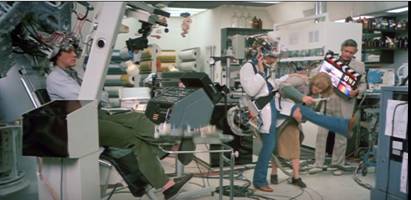
The above image is from the opening scene of the movie "Brainstorm" (1983) in which "Scientists invent a brain-computer interface enabling sensations to be recorded from a person's brain and converted to tape for others to experience." Wikipedia: Brainstorm (1983) What was once science fiction is becoming technological reality, with profound implications for human consciousness and identity.
The Drive to Mastery
Michael J. Sandel writes in his paper "What's Wrong with Enhancement" (2002), presented at The President's Counsil On Bioethics, that:
"I do not think that the main problem with enhancement and genetic engineering is that they undermine effort and erode human agency. The deeper danger is that they represent a kind of hyper-agency, a Promethean aspiration to remake nature, including human nature, to serve our purposes and satisfy our desires. The problem is not the drift to mechanism but the drive to mastery. And what the drive to mastery misses and may even destroy is an appreciation of the gifted character of human powers and achievements."
This drive to mastery represents a fundamental departure from accepting human nature as it has evolved over millions of years. Rather than working with our existing capabilities and limitations, transhumanism seeks to redesign human consciousness according to abstract ideals of optimization and perfection.
The Inevitability Argument
The integration of humans with artificial intelligence systems may become a necessity rather than a choice. In a Mar 27, 2023 interview (21:47-22:10) with Dwarkesh Patel, Ilya Sutskever (OpenAI Chief Scientist) revealed the compelling nature of enhancement:
Ilya: "I also think that because the world will change a lot, it will be very hard for people to understand what is happening precisely and how to really contribute. One thing that I think some people will choose to do is to become part AI. In order to really expand their minds and understanding and to really be able to solve the hardest problems that society will face then."
Dwarkesh Question: "Are you going to become part AI?"
Ilya: "It is very tempting."
Shortly after in the interview (23:30-23:45), Ilya Sutskever commented:
"I'd much rather have a world where people are still free to make their own mistakes and suffer their consequences and gradually evolve morally and progress forward on their own with their own strength, with the AGI providing more like a base safety net."
This tension captures the fundamental dilemma: even those developing advanced AI systems recognize the value of authentic human experience while feeling compelled toward enhancement by the technologies they create.
The Transformation of Human Consciousness
A profound transformation of human cognition and consciousness looms as brain-computer interfaces advance. Nick Bostrom warns that "as artificial systems become more advanced, there is a risk that they will eventually surpass human biological components in both efficiency and capability." Nick Bostrom, "Superintelligence: Paths, Dangers, Strategies" (2014), p. 125. This superiority could lead to the gradual replacement of human attributes with artificial ones.
The progression toward human enhancement follows an inexorable logic similar to technological adoption. Once initiated, enhancement becomes self-perpetuating as enhanced individuals gain advantages, creating pressure for others to follow suit. This mirrors the psychological pattern captured in the "Betcha can't eat just one" marketing principle - initial adoption leads to continuing escalation.
By the way, "Let me tell you there's more where that came from." The line is spoken, by the character Joker, in the movie "The Dark Knight" (2008) during a scene that highlights his chaotic and unpredictable nature. The line previously appeared in Douglas Clegg's horror novel "The Abandoned" (2005) in the following passage:
In the near future the "voice" is likely to be Claude's voice ;^).
The Enhancement Trap
Even an aligned artificial superintelligence might accelerate rather than mitigate transhumanist developments. The availability of safe, effective enhancement options could create irresistible pressures for humans to modify themselves, potentially leading to more dramatic alterations of human nature than initially anticipated.
An aligned ASI would likely make genetic engineering and human enhancement technologies safer and more effective. However, this could actually accelerate transhumanist trends rather than mitigate them. The availability of highly advanced enhancement options might create strong pressures, social, economic, or otherwise, for humans to alter themselves, potentially leading to more significant changes to human nature than initially estimated.
The choice between enhancement and preservation may not remain individual for long. As enhancement technologies become available, competitive pressures in education, work, and society could create cascading adoption where those who remain unenhanced face mounting disadvantages. This dynamic could force humanity down the path of enhancement regardless of philosophical reservations.
The Incompatibility with Human Nature
A fundamental incompatibility exists between transhumanist enhancement and the preservation of quintessential human nature. Erich Fromm's prescient warning resonates: "The danger of the future is that men may become robots. True enough, robots do not rebel. But given man's nature, robots cannot live and remain sane, they become 'golems,' they will destroy their world and themselves because they cannot stand any longer the boredom of a meaningless life."
The dystopian society depicted in the Netflix movie "Uglies" illustrates how the pursuit of enhancement, even cosmetic perfection—exacts costs far beyond physical transformation, ultimately diminishing human authenticity and meaning.
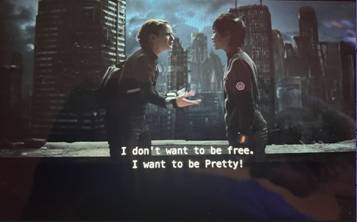
The image is from the Netflix movie "Uglies" presenting a dystopian society where the costs for beauty is more than physical transformation.
An aligned ASI would indeed consider human values, but the risk of technological dehumanization might remain high or even increase. Even with benevolent intentions, the rapid advancement and integration of technology could fundamentally alter human experiences and interactions. An aligned ASI might optimize for efficiency or what it perceives as human well-being in ways that inadvertently reduce human agency or traditional forms of human connection.
The Question of Preservation
The preservation of humanity's fundamental nature, our emotions, flaws, creativity, and biological essence, represents more than sentimental attachment to our current form. These characteristics have shaped our art, culture, relationships, and innovations throughout history, creating a rich tapestry of human experience that gives life its depth and meaning.
Transhumanist technologies promise extraordinary benefits: the elimination of suffering, radical life extension, enhanced cognitive capabilities, and solutions to humanity's greatest challenges. Yet these benefits come with a profound risk, that in optimizing human capability, we may inadvertently eliminate the very qualities that make human experience meaningful and unique. The pursuit of perfection could lead to a kind of hollow optimization where we gain power but lose purpose.
The fundamental incompatibility between transhumanist enhancement and traditional human nature cannot be resolved through compromise or careful balancing. Each enhancement may seem beneficial in isolation, but their cumulative effect leads toward a post-human future where increased capability comes at the cost of authentic human experience.

The above left image is from the popular 1960's advertising Lay's potato chips slogan "Betcha can't eat just one". The image on the right is from the Lay's brand's latest advertising campaign (2024) "Betcha Can't Pick Just One".
The Loss of Authentic Experience
Transhumanism's promise of increased capabilities might actually reduce human agency by making individuals increasingly dependent on technologies they cannot fully understand or control. Enhanced beings may possess superior cognitive abilities while losing the direct, unmediated relationship with reality that characterizes authentic human experience.
The interplay of instinctual algorithms and moderate intelligence that produces romantic sensibility requires specific conditions to flourish, conditions that technological enhancement systematically disrupts. When human consciousness becomes integrated with artificial systems, the delicate balance between emotion and reason, instinct and reflection, that creates quintessential human qualities becomes impossible to maintain.
The role of limitation and imperfection in creating meaning becomes particularly relevant here. Human experiences of love, loss, growth, and change derive their significance partly from their occurrence within natural constraints. Enhanced beings operating beyond these constraints may find themselves capable of extraordinary achievements while experiencing a profound emptiness where human meaning once resided.
The Path to Post-Humanity
The trajectory toward post-humanity follows a logic that makes each step seem reasonable while leading toward a destination that fundamentally abandons human nature. What begins as medical intervention to restore function becomes enhancement to improve capability, which becomes optimization to maximize potential, which ultimately becomes transformation into something no longer recognizably human.
This progression occurs not through dramatic leaps but through incremental changes that each appear beneficial in isolation. The cumulative effect, however, represents a complete departure from the evolved human consciousness that has created everything we value about human culture, relationships, and meaning-making.
The question becomes whether humanity can recognize the value of what it risks losing before the transformation becomes irreversible. Preserving humanity's humanity isn't just worthwhile, it may be essential for maintaining the qualities that make existence meaningful, even if it means accepting certain limitations on our potential capabilities.
The fundamental choice before us involves whether to enhance human capabilities at the cost of human nature, or to preserve authentic human experience within its natural limitations. This choice may determine not only what humans become, but whether anything recognizably human survives the transition to a technologically enhanced future.